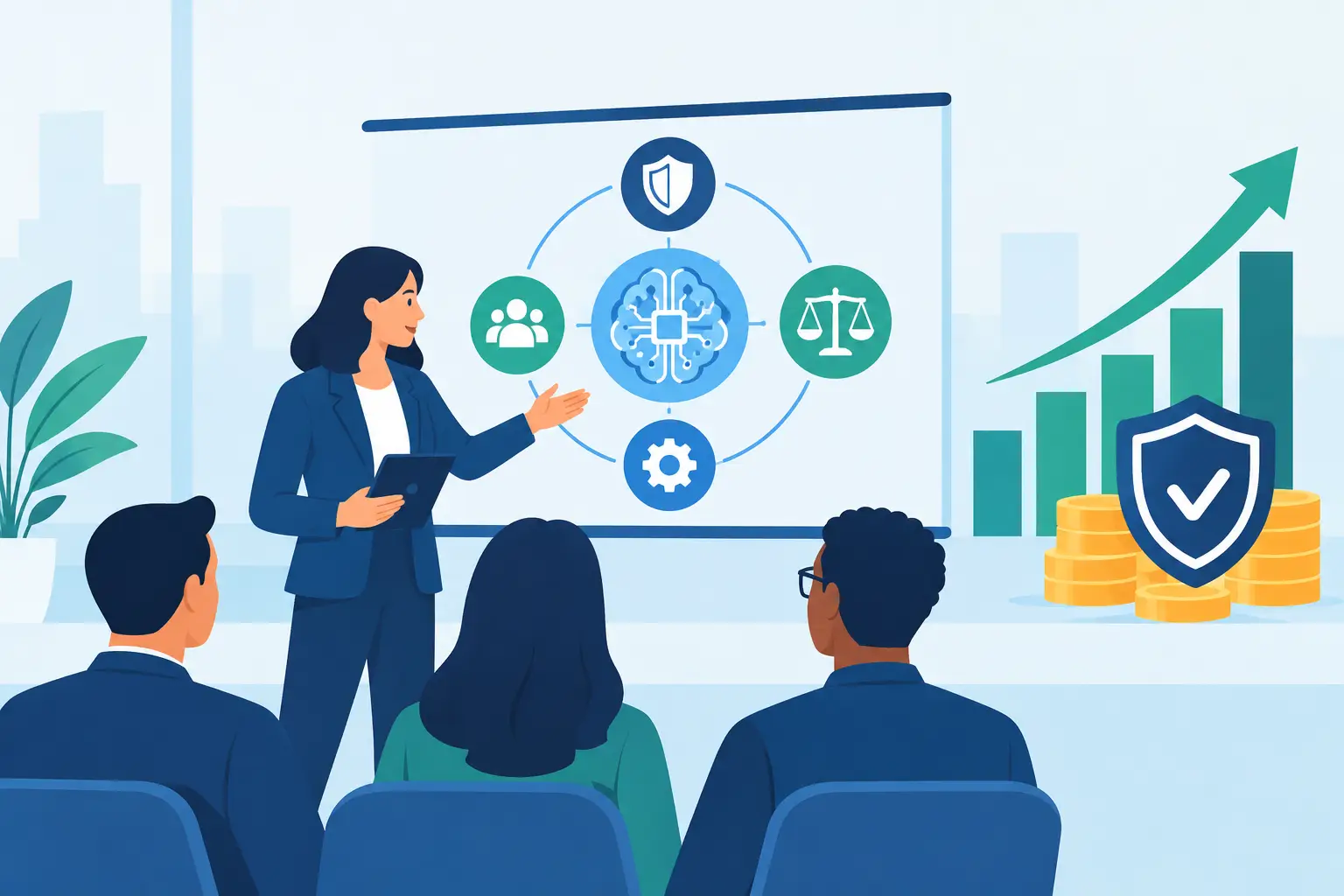
A generative AI pilot can look successful right up to the point it reaches a regulated process, exposes confidential knowledge, or produces an answer nobody is authorised to approve. AI governance training is not a compliance exercise added after experimentation. It is the operating discipline that lets an organisation move quickly without handing decision rights, risk, and business value to a tool.
For established enterprises, the difficulty is rarely a lack of AI ideas. It is that those ideas must operate across legacy estates, complex supplier arrangements, fragmented data ownership, and obligations that cannot be paused for an innovation programme. AI does not wait. Neither do auditors, customers, regulators, or the operational teams expected to rely on the result.
Why AI governance fails in mature organisations
Many governance programmes begin with a policy. The policy names acceptable use, privacy principles, security expectations, and perhaps an approval route. Those are necessary foundations, but they do not answer the questions delivery teams face on a Tuesday afternoon: Can this model be used to support a credit decision? Who checks whether its source data is current? What happens when an employee pastes a customer record into an unapproved service? Which business owner can accept the residual risk?
If those questions have no clear answers, people either stop work and wait, or proceed through informal channels. The first outcome slows investment. The second creates shadow AI, inconsistent controls, and a poor evidence trail when something goes wrong.
The underlying issue is usually not technology. It is an unclear operating model. Decision rights are scattered between security, legal, data, risk, architecture, procurement, and business functions. Each team sees a valid part of the problem, yet nobody owns the full path from use case to accountable operation.
This is especially acute where business knowledge lives inside older applications, batch processes, long-tenured teams, and undocumented workarounds. A model can produce plausible recommendations while missing the conditions embedded in those systems. Replacing or bypassing legacy technology without understanding its rules may remove the very knowledge that protects customers, revenue, and compliance.
What AI governance training must change
Effective training changes behaviour at the point decisions are made. It gives leaders and delivery teams a shared method for judging an AI use case before it becomes expensive, politically difficult, or unsafe to reverse.
That does not mean making every employee a machine-learning specialist. A procurement leader needs different depth from an enterprise architect; a product owner needs different depth from a model risk specialist. The common requirement is practical judgement: understanding what the system does, what it is allowed to influence, what evidence is required, and who remains accountable.
A useful programme teaches four connected capabilities.
First, participants must distinguish assistance from authority. AI can draft, classify, retrieve, predict, or recommend. None of those functions automatically justifies allowing it to make a decision. The greater the effect on an individual, a financial position, a safety outcome, or a regulated commitment, the stronger the oversight and traceability should be.
Second, they need to assess data and knowledge fitness. The question is not merely whether data exists. It is whether the data is accurate enough for the purpose, lawful to use, current, protected, and interpretable in its business context. Institutional knowledge matters here. A retired product code, exception rule, or manual control may look like clutter until it explains why a process produces a reliable result.
Third, teams need lifecycle discipline. A use case is not governed only at approval. It needs defined monitoring, change control, incident response, review triggers, and retirement conditions. A model, prompt library, retrieval source, or supplier service can change its behaviour or risk profile after launch. Governance must follow the service, not the presentation deck.
Finally, training must make escalation normal rather than punitive. People should know when to pause, whom to involve, and how to record a decision. An organisation that treats every escalation as failure will receive fewer warnings, not fewer risks.
AI governance training is an operating-model decision
The strongest programmes start with the organisation’s value chain rather than a generic catalogue of AI principles. A claims operation, a manufacturing planning process, and a corporate knowledge assistant do not carry the same consequences. They should not inherit the same approval burden.
This is where proportionality matters. Requiring the same assessment for a low-risk internal drafting assistant and an AI-supported eligibility decision wastes time and encourages workarounds. Conversely, a lightweight checklist is inadequate where outputs influence customers, regulated records, payments, or health and safety.
Training should therefore teach a tiered approach. Teams learn to classify use cases by impact, autonomy, data sensitivity, reliance on external providers, and reversibility. Higher-risk work receives deeper scrutiny, clearer human accountability, stronger testing, and more frequent monitoring. Lower-risk work can move through a faster path with defined guardrails.
The practical benefit is speed with evidence. Leaders can see why a use case was approved, constrained, redesigned, or declined. Delivery teams know the route before they commit months of build effort. Risk functions gain a consistent basis for challenge rather than being asked to react to a finished product.
Roles must be explicit
An AI governance framework often names committees but overlooks the people who make daily trade-offs. Training should clarify the responsibilities of business sponsors, product owners, data owners, architects, security teams, legal and compliance specialists, procurement, and operational users.
The business sponsor owns the outcome and the case for value. The product owner owns how the service operates. Architecture determines whether the design fits the wider estate and its dependencies. Risk and control functions define required safeguards and challenge assumptions. No single role can delegate its accountability to an AI supplier or a model.
This clarity prevents a common failure: treating governance as the responsibility of a central AI team. A central function can set standards, provide methods, and maintain oversight. It cannot understand every customer promise, process exception, or operational consequence across the enterprise.
Architecture turns policy into usable control
Policies say what must be true. Architecture makes it possible to demonstrate that it is true.
Consider a knowledge assistant connected to internal documents. Governance requires access control, source attribution, retention rules, testing, and monitoring. Architecture determines where documents are retrieved, how permissions are inherited, how prompts and outputs are logged, how sensitive material is separated, and how the service can be withdrawn if a defect is found.
The same applies to legacy systems. Not every technical debt blocks AI value. Some debt creates material exposure because it prevents identity control, reliable data lineage, integration monitoring, or recovery. Other debt can be deferred while a useful service is delivered. Training should help leaders identify the constraint, estimate its business effect, and make a deliberate funding decision.
Indiscriminate modernisation is not governance. It is expenditure without a clear relationship to risk reduction or return. The better question is: which architectural changes make this AI-enabled service safe, supportable, and commercially worthwhile?
A practical structure for the programme
Training works best when it is anchored in live decisions, not abstract scenarios alone. Start by selecting a small set of representative use cases: one internal productivity use case, one customer-facing use case, and one process that depends on legacy knowledge or sensitive data. These create a realistic basis for discussion across functions.
Participants should work through the same sequence they will use after the course: define the intended outcome; identify affected people and processes; map data, systems, suppliers, and knowledge dependencies; assess risks and decision rights; establish controls; then define measures for value and ongoing assurance.
The output should be usable artefacts, not merely attendance records. Teams may produce a use-case assessment, an accountability map, a risk-tiering model, design principles, approval criteria, and monitoring measures. The exact artefacts depend on organisational maturity, but each must support a real decision.
Measures deserve particular attention. Training completion rates are easy to report and say little about readiness. Better measures include the proportion of use cases assessed before build, time taken to route decisions, unresolved control gaps, incidents detected through monitoring, and realised business value against the original case. Work is measured by what it returns.
Building capability without creating a bureaucracy
There is a trade-off between central consistency and local speed. A heavily centralised model can control standards but become a bottleneck. A fully distributed model can encourage adoption but produce inconsistent evidence and duplicated mistakes. Most mature organisations need a federated approach: a central capability sets minimum expectations and provides specialist support, while business domains retain ownership of their use cases.
Resilient ROI approaches this as organisational enablement, not a policy-writing exercise. The objective is to build repeatable judgement across the people who sponsor, design, procure, operate, and assure AI-enabled services. That includes protecting the business knowledge within existing technology estates rather than assuming the estate is simply an obstacle to remove.
Training must also be revisited. Regulatory expectations evolve, suppliers change their products, new use cases alter the organisation’s exposure, and teams learn from operation. A yearly slide refresh is unlikely to be enough. Short, decision-led sessions tied to emerging patterns are often more useful than broad retraining.
The next AI proposal should not have to prove that your organisation is ready from scratch. Give its sponsors a clear route, give its reviewers the evidence they need, and make accountability visible before value is put at risk.